AIMS:
The intricate relationship between coronary microvascular dysfunction (CMD) and ST-segment elevation myocardial infarction (STEMI) poses substantial clinical challenges. CMD, a frequent complication of STEMI, can lead to poor cardiovascular outcomes and persistent symptoms. However, the association between post-STEMI CMD and the ensuing left ventricle (LV) diastolic dysfunction and functional remodelling remains insufficiently investigated.
METHODS AND RESULTS:
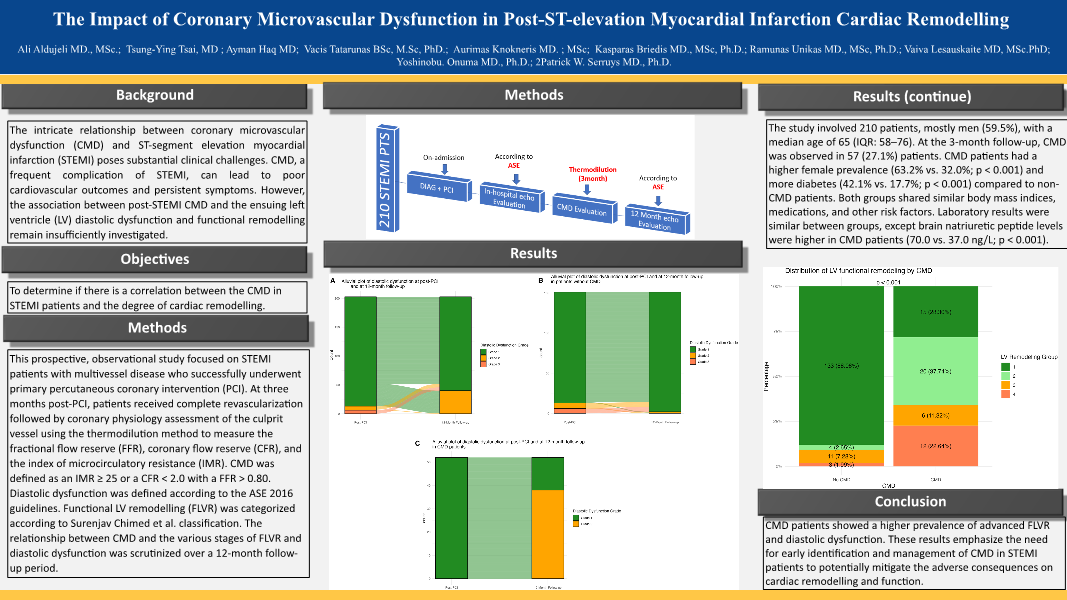
Methods: This prospective, observational study focused on STEMI patients with multivessel disease who successfully underwent primary percutaneous coronary intervention (PCI). At three months post-PCI, patients received complete revascularization followed by coronary physiology assessment of the culprit vessel using the thermodilution method to measure the fractional flow reserve (FFR), coronary flow reserve (CFR), and the index of microcirculatory resistance (IMR). CMD was defined as an IMR ≥ 25 or a CFR < 2.0 with a FFR > 0.80. Diastolic dysfunction was defined according to the ASE 2016 guidelines. Functional LV remodelling (FLVR) was categorized according to Surenjav Chimed et al. In brief, patients were classified into four groups based on the degree of LV remodelling, with Group I being the least affected and Group IV showing the most adverse remodelling. Group I includes patients with no significant changes in LV end-diastolic volume (LVEDV) or left ventricular ejection fraction (LVEF); Group II comprises patients with no LV dilatation but a decrease in LVEF greater than 5%; Group III consists of patients with an increase in LVEDV of 20% or more, without LVEF impairment; Group IV includes patients who experienced both an increase in LVEDV of at least 20% and a decline in LVEF exceeding 5%. The relationship between CMD and the various stages of FLVR and diastolic dysfunction was scrutinized over a 12-month follow-up period. Results: The study enrolled 210 patients, predominantly men (59.5%), with a median age of 65 years (IQR: 58–76). At the 3-month follow-up, CMD was observed in 57 (27.1%) patients (all with IMR≥25). After 12 months, CMD patients demonstrated significantly less recovery in LV systolic function (-10.00% vs. 8.00%; p < 0.001), higher prevalence of grade 2 LV diastolic dysfunction (73.08% vs. 1.32%; p < 0.001), and a higher incidence of advanced FLVR (notably in Groups 3 and 4) compared to those without CMD (11.32% vs. 7.28% and 22.64% vs. 1.99%, respectively; p < 0.001). In multivariable logistic regression analysis, IMR values at 3 months were independently associated with more severe grades of FLVR and diastolic dysfunction.
CONCLUSION:
CMD was identified in over one in four STEMI patients at the 3-month follow-up. These patients showed a higher prevalence of advanced FLVR and diastolic dysfunction. These results emphasize the need for early identification and management of CMD in STEMI