AIMS:
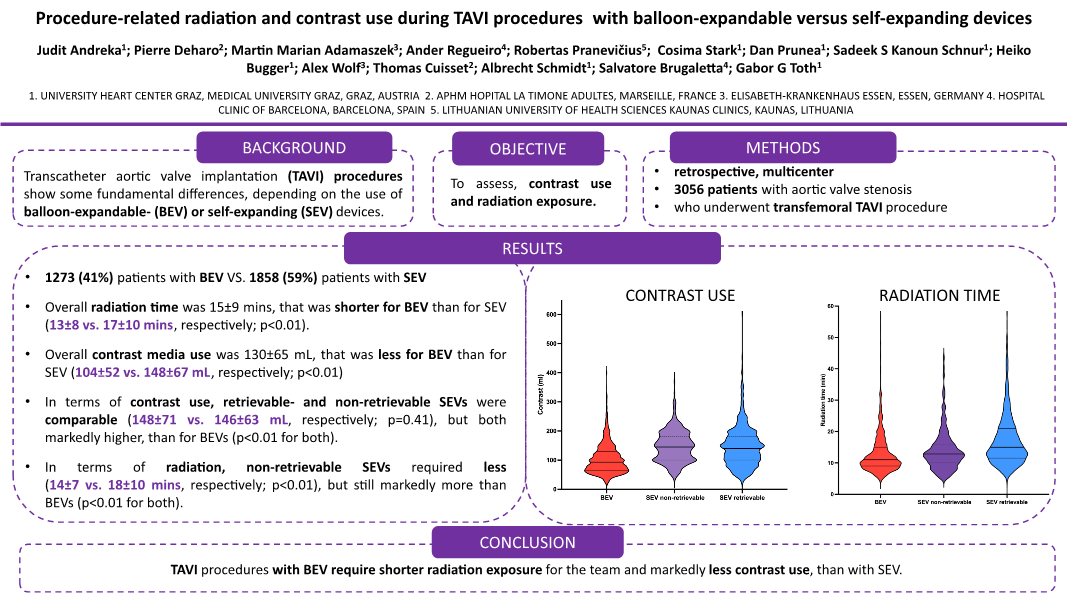
Transcatheter aortic valve implantation (TAVI) procedures show some fundamental differences, depending on the use of balloon-expandable- (BEV) or self-expanding (SEV) devices. We aimed to assess, how it translates into contrast use and radiation exposure.
METHODS AND RESULTS:
From five high volume European centers consecutive patients were included, who underwent transfemoral TAVI procedure. Patient- and procedural characteristics were recorded and compared in relation to the used TAVI device. In total 3131 patients were included. 53% were male and the mean age was 80±9 years. 1273 (41%) patients were treated with BEV, while 1858 (59%) with a SEV system. Patients, receiving SEV were older (81±9 vs 79±9 years, respectively; p<0.01) and were more often females (57% vs 33%, respectively; p<0.01). There was also a trend for less peripheral artery disease (14% vs 17%, respectively; p=0.06). Overall total radiation time was 15±9 mins, that was markedly shorter for BEV than for SEV (13±8 vs. 17±10 mins, respectively; p<0.01). On average 130±65 mL contrast media was used, that was less for BEV than for SEV (104±52 vs. 148±67 mL, respectively; p<0.01) In terms of contrast use, retrievable- and non-retrievable SEVs were comparable (148±71 vs. 146±63 mL, respectively; p=0.41), but both markedly higher, than for BEVs (p<0.01 for both). Non-retrievable SEVs required less radiation (14±7 vs. 18±10 mins, respectively; p<0.01), but still markedly more than BEVs (p<0.01).
CONCLUSION:
TAVI procedures with BEV require shorter radiation exposure for the team and markedly less contrast, than with SEV. This might be reasonable to consider during patient-tailored procedure planning.