AIMS:
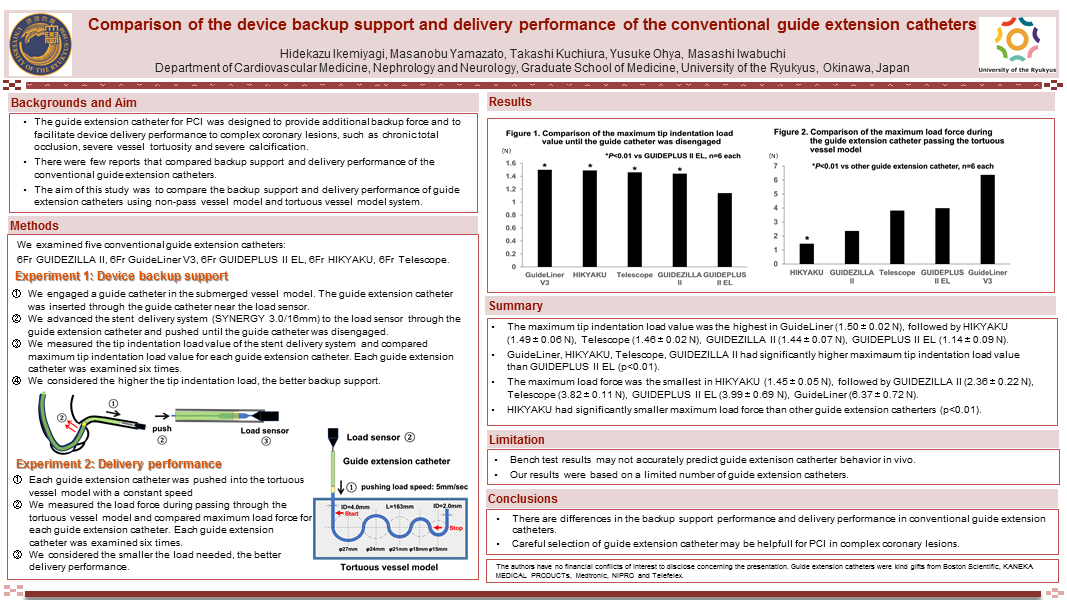
The guide extension catheter for percutaneous coronary intervention (PCI) was designed to provide additional backup force and to facilitate device delivery performance to complex coronary lesions, such as chronic total occlusion, severe vessel tortuosity and severe calcification. There were few reports that compared backup support and delivery performance of the conventional guide extension catheters. The aim of this study was to compare the backup support and delivery performance of the guide extension catheters with using a non-pass vessel model and a tortuous vessel model system.
METHODS AND RESULTS:
We examined five conventional guide extension catheters: 6Fr GUIDEZILLA ll, 6Fr GuideLiner V3, 6Fr GUIDEPLUS II EL, 6Fr HIKYAKU, 6Fr Telescope. We used same guide catheter and stent derivery system for every experiment. First, we engaged a guide catheter in the submerged vessel model. The guide extension catheter was inserted through the guide catheter near the load sensor. Then, we advanced the stent derivery system to the load sensor through the guide extension catheter and pushed until the guide catheter was disengaged. We measured the tip indentation load value of the stent delivery system and compared maximum tip indentation load value for each guide extension catheter. Each guide extension catheter was examined six times. We considered the higher the tip indentation load, the better backup support. The indentation load value was the highest in GuideLiner (1.50±0.02 N), followed by HIKYAKU (1.49±0.06 N), Telescope (1.46±0.02 N), GUIDEZILLA ll (1.44±0.07 N), GUIDEPLUS II EL (1.14±0.09 N). GuideLiner, HIKYAKU, Telescope, GUIDEZILLA ll had significantly higher tip indentation load value than GUIDEPLUS II EL (p<0.01). Next, each guide extension catheter was pushed into the tortuous vessel model with a constant speed and we measured the load force during passing through the vessel model. Each guide extension catheter was examined six times. We considered the smaller the load needed, the better delivery performance. The load force was the smallest in HIKYAKU (1.45±0.05 N), followed by GUIDEZILLA ll (2.36±0.22 N), Telescope (3.82±0.11 N), GUIDEPLUS II EL (3.99±0.69 N), GuideLiner (6.37±0.72 N). HIKYAKU had significantly smaller load force than other guide extension catherters (p<0.01).
CONCLUSION:
These results suggested that there are differences in the backup support performance and delivery performance in conventional guide extension catheters. Careful selection of guide extension catheter may be helpfull for PCI in complex coronary lesions.